
Why cats love boxes (science explains)

An informative guide based on recognised veterinary sources. If you notice any symptoms, always see your vet.
It's almost a universal law: you buy your cat a toy or a bed and, as soon as you open the parcel, they climb into the cardboard box and there's no getting them out. The same goes for drawers, open suitcases, bags and laundry baskets. It looks like a whim, but there are good reasons behind it, and some have been studied by scientists.
1. A box is a refuge from stress
Cats are both hunters and potential prey for larger animals. Their strategy when something unsettles them is almost never to confront it: it's to hide and watch. An enclosed space, with walls on the sides and a single entrance, lets them feel protected while keeping an eye on what's happening outside.
In 2014, a team from Utrecht University (Netherlands), including researcher Claudia Vinke, published a study in the journal Applied Animal Behaviour Science involving 19 cats newly arrived at a shelter. Ten of them were given a box to hide in and the other nine weren't. Their stress levels were measured over 14 days using a behavioural scale.
The result: the cats with a box showed less stress in the first few days and by around day three reached a level of calm that the other group didn't reach until the end of the two weeks. The authors concluded that a hiding box seems to be an important resource for adapting to a new environment. A later study by the same group, published in PLOS ONE in 2019, found similar benefits.
2. It keeps them warm
Cats are comfortable at higher temperatures than we are. Cardboard is a good insulator, and a small space holds in the cat's own body heat. It's no coincidence that in winter they seek out boxes, blankets and snug corners even more.
3. It's the perfect hunting hide
From inside a box, a cat can lie in wait without being seen. Many hunting games start exactly like this: a cat crouched in a box, pupils dilated, waiting for a toy (or your feet) to go past so they can pounce.
4. "If I fits, I sits": even in imaginary squares
You've probably seen photos of cats sitting inside a square of tape on the floor. In 2021, researchers from Hunter College, City University of New York (Gabriella Smith and her team) studied this with a citizen science experiment published in Applied Animal Behaviour Science.
They asked cat owners to place a real square, a control shape and an optical illusion called a Kanizsa square on the floor: four Pac-Man-shaped pieces that make the brain see a square that isn't actually there. Of the 30 people who completed the experiment, 9 cats chose one of the shapes. Across 16 choices, the cats picked the real square 8 times, the illusory square 7 times and the control shape just once.
The sample is small, so the authors themselves urge caution. But it does suggest something intriguing: cats are drawn to outlines that "enclose" a space, even if they're only an illusion.
How to make the most of their love of boxes
- Always leave a hiding place available. Especially if you have visitors, building work, a new animal or a house move.
- Offer hiding places at different heights. Many cats like to hide up high, on a shelf or on top of a wardrobe.
- If you adopt a cat, prepare a quiet room with a box or enclosed bed. It will help them settle in during the first few days.
- Turn the box into a game. Cut a couple of holes and put a toy inside, or join several boxes together to create a little circuit.
- Check boxes before using them. Remove staples, tape, plastic and handles they could get caught on.
- Don't pull them out by force. If they've hidden, it's because they need to. Respecting their refuge builds their trust.
What if the box is worn out?
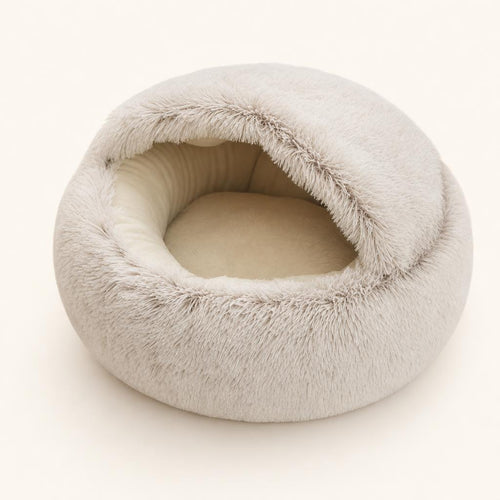
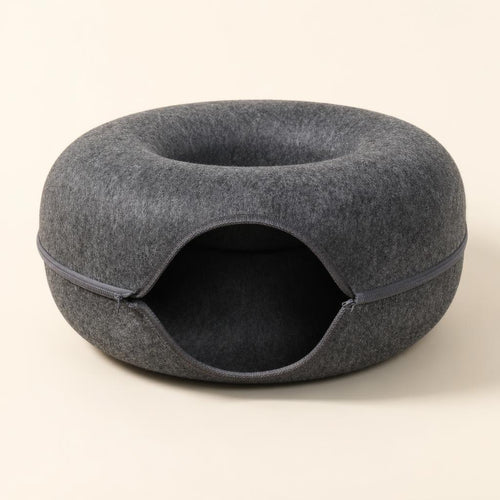
Cardboard eventually gets torn, scratched and squashed. A long-lasting alternative is a cave-style bed or a felt tunnel, which do the same job: protective walls, an entrance to keep watch from and a warm inside. Place them somewhere quiet, away from busy areas.
In short: your cat loves boxes because they give them security, warmth and a great hunting spot. A hiding place isn't a luxury: it's essential to their wellbeing.
In the Katlune guides you'll find more ideas for creating a home tailored to your cat, and Club Katlune brings you practical tips like these every week.
Sources: Vinke, C. M., Godijn, L. M. and van der Leij, W. J. R. (2014), "Will a hiding box provide stress reduction for shelter cats?", Applied Animal Behaviour Science, Utrecht University; van der Leij, W. J. R. et al. (2019), PLOS ONE; Smith, G. E., Chouinard, P. A. and Byosiere, S.-E. (2021), "If I fits I sits: A citizen science investigation into illusory contour susceptibility in domestic cats", Applied Animal Behaviour Science.
The Katlune solution
What we recommend to help
Club Katlune members get a discount across the whole shop.
Katlune's information is for general guidance only and is no substitute for diagnosis or treatment by a veterinary professional.


