
Is your cat cold? What they need in winter (and why they love the radiator)

An informative guide based on recognised veterinary sources. If you notice any symptoms, always see your vet.
As soon as the cold weather arrives, your cat disappears: you find them pressed against the radiator, curled up on the sofa blanket, tucked under the duvet or stretched out in the only ray of sunshine in the living room. It's not laziness. Cats need more warmth than we do to feel comfortable, and in winter they really feel it.
An animal that lives "at 30 degrees"
All warm-blooded animals have a thermal comfort zone (thermoneutral zone): the temperature range in which they don't spend extra energy warming up or cooling down. According to US National Research Council data cited in the veterinary publication Veterinary Ireland Journal, for cats this zone lies between 30 and 38 °C. By comparison, in people it's around 18–25 °C and in dogs 20–30 °C.
In other words, at the usual temperature of a home in winter, your cat is probably below their ideal zone. That's why they seek out sources of heat: the sun, the radiator, your lap or your laptop.
Why they sleep more in winter
Cats are big sleepers to begin with. The Sleep Foundation (United States) reports that more than half of cats sleep between 12 and 18 hours a day, and kittens and older cats may sleep even more. Their sleep is also polyphasic: it's spread across lots of naps throughout the day and night.
In winter, with fewer hours of daylight and colder weather, it's normal for them to spend more time curled up. That ball-shaped posture, with the tail covering the nose, reduces the exposed surface area and helps hold in heat.
A word of caution: if you notice your cat sleeping much more than usual, seeming listless, eating less or hiding, don't put it down to the cold alone. Talk to your vet.
Cats that find the cold harder
- Older cats, especially if they have arthritis: the cold can increase stiffness and discomfort.
- Kittens, who are less able to regulate their temperature.
- Short-haired or hairless cats.
- Thin or ill cats, with fewer reserves to produce heat.
How to help your cat through the winter
- Offer warm, snug beds. Cave-style beds, plush beds or beds with high sides hold in body heat very well. Place them away from draughts and slightly raised off the cold floor.
- Make the most of the sun. A window hammock or a blanket by a sunny window is a real treat for them on winter days.
- Take care with direct heat sources. Cats can get too close to heaters, stoves or open fires and singe their fur or burn their skin. Use guards and don't leave them alone near flames or lit stoves.
- Keep water within reach. Central heating dries out the air and some cats drink even less in winter. Change the water daily and offer several water stations.
- Keep playing. A few minutes of active play a day helps them stay fit and avoid putting on weight during the months when they move less.
- Brush them regularly. A clean, tangle-free coat insulates better against the cold.
If your cat goes outdoors
- Check the car before starting it. In winter, some cats shelter under cars or near the engine, which stays warm for hours. Bang on the bonnet a few times before you start the engine.
- Make sure they can get back into the house or have a dry, sheltered refuge.
- Beware of antifreeze. It's highly toxic to cats and has a taste that can attract them. Clean up any spills and keep it tightly closed.
- Dry them off if they come in wet, especially their paws, and check their pads.
Christmas and a warm home
At this time of year, with visitors, noise and decorations, your cat will appreciate having a warm, quiet corner all to themselves, away from the hustle and bustle, even more. An enclosed bed in a quiet room could be the best present you give them.
In short: your cat isn't exaggerating — they really do need more warmth than you. Warm beds, sunshine, fresh water and daily play are the recipe for a happy winter.
In the Katlune guides you'll find more seasonal tips, and in Club Katlune we send you ideas every week for caring for your cat all year round.
Sources: Veterinary Ireland Journal, "The heat is on: the feline thermoneutral zone" (with data from the US National Research Council); Sleep Foundation, "How much do cats sleep?".
The Katlune solution
What we recommend to help
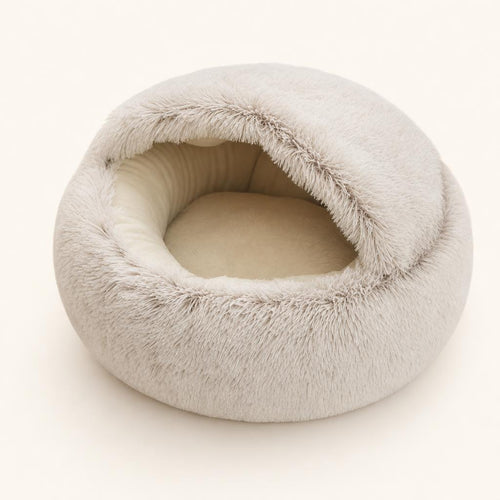 Plush cave bed for cats
34,99 €
View product →
 Window hammock for cats with suction cups
32,99 €
View product →
Club Katlune members get a discount across the whole shop.
Katlune's information is for general guidance only and is no substitute for diagnosis or treatment by a veterinary professional.


